The Behram Pasha Mosque — the “prince of provincial mosques” in Diyarbakır
Among the mosques of Diyarbakır, there is one about which architectural historian Godfrey Goodwin wrote in 1971: “This is, truly, the prince of provincial mosques—as magnificent in its decoration as in its proportions, within the framework of a strict local style.” The Behram Pasha Mosque—a 16th-century Ottoman structure commissioned by the governor of Diyarbakır and presumably associated with the name of Sinan himself—is one of the most sophisticated examples of the synthesis of imperial and local architectural traditions. The black-and-white masonry of basalt and limestone, the dome with a diameter of 15.9 meters, and the tiles produced in Diyarbakır—all of this makes the Behram Pasha Mosque a must-see stop on a historical tour of the city.
History and Origin of the Behram Pasha Mosque
The mosque was founded by order of Behram Pasha, the Ottoman governor (beylerbey) of Diyarbakır. The exact dates of his governorship are unknown, but the most likely period is between 1564–65 and 1567–68. Behram Pasha himself was the son of Kara Shahin Mustafa Pasha, who had previously served as governor of Yemen and Egypt—that is, he belonged to the highest administrative elite of the Ottoman Empire. Behram Pasha died in 1585 and was buried in Aleppo.
Construction began around 1564–65. The completion date—1572–73 (AH 980)—is preserved in an Arabic inscription above the entrance portal. This dating text is the primary documentary evidence for the chronology of the building’s construction.
The question of the architect remains open and subject to debate. In one of the architect’s two major autobiographical works—Tuḥfetü'l-mi'mārīn—the mosque is mentioned in the list of Sinan’s works. However, it is absent from his other text, Tezkiretü'l-ebniye. Researchers believe that this contradiction points to Sinan’s marginal role in the project: he may have merely approved the plans in Istanbul, while the actual construction was overseen by another architect—either an imperial architect specially sent from the capital or a highly skilled local master. The latter version is supported by the characteristic use of local architectural techniques alongside those typical of the Ottoman style.
It is noteworthy that the black-and-white ablak masonry—alternating rows of black basalt and white limestone—is atypical for Constantinople mosques but fits naturally into Diyarbakır, where it is part of the regional building tradition. This confirms that the construction crew consisted of local masons and craftsmen who were well-versed in the language of Diyarbakır architecture.
Architecture and What to See
The Behram Pasha Mosque combines the monumentality of the Ottoman style with the intimacy of local details. Both inside and out, the building offers a wealth of material for those who can read architecture.
Facade and Portico
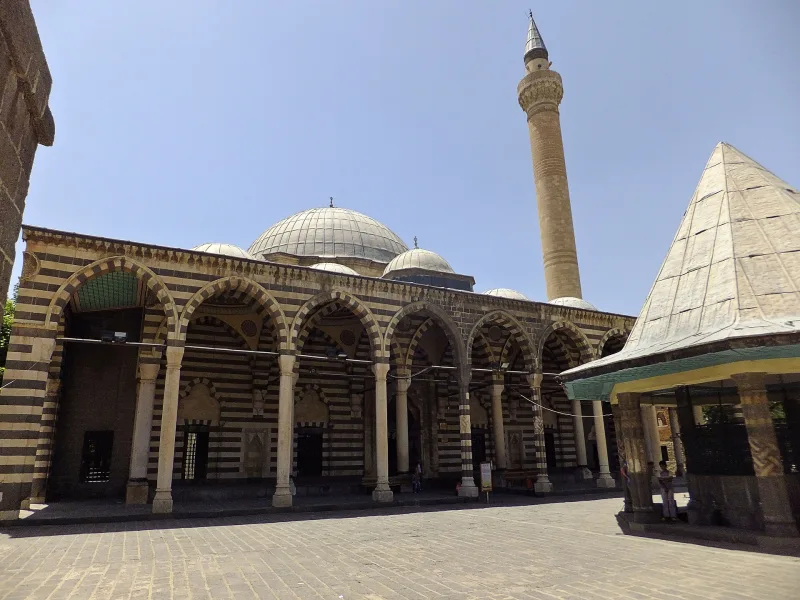
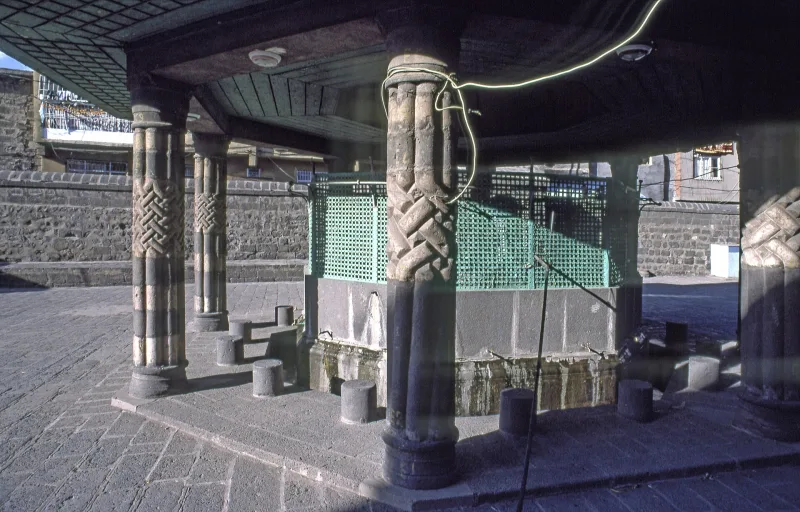
The north facade is built in alternating horizontal bands of black and white stone—the ablak technique, inherited from the Syrian-Mamluk tradition and widespread in Southeastern Anatolia. In front of the entrance stands a double portico with five domes. The two central columns of the outer portico feature characteristic twisted middle sections made of alternating rows of black and white stone. The remaining columns of the portico are made of white marble. The single minaret is located in the northwest corner of the portico.
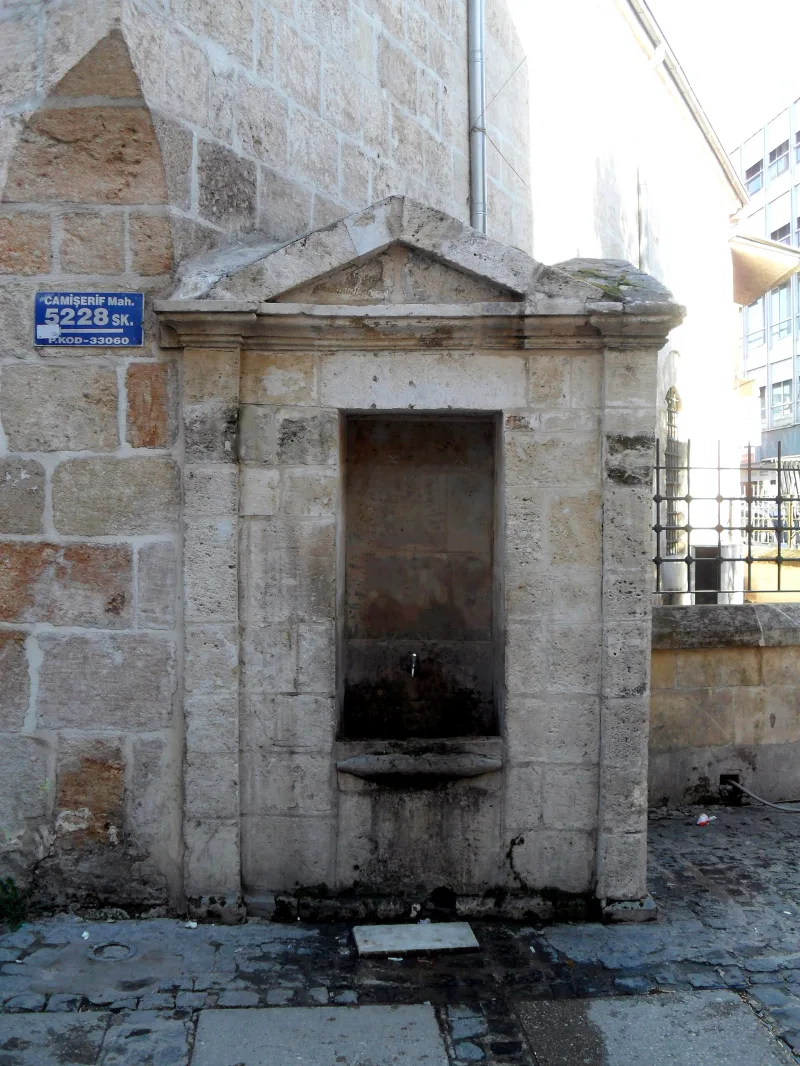
Opposite the central portal of the northern facade stands an octagonal drinking fountain. Its pyramidal roof rests on composite columns of black and white stone with twisted middle sections—these intentionally echo the columns of the portico, creating a unified ensemble.
Dome and Interior
The main volume of the mosque is a square without additional naves, covered by a single dome with a diameter of 15.9 meters (52 feet). The dome rests on a sixteen-sided drum with windows on each face. Eight pointed arches support the dome from within, giving the prayer hall a sense of lightness and spaciousness. Diffused light passing through the drum’s 16 windows fills the interior with an even, daylight glow.
Tile Decoration
The lower parts of the prayer hall’s walls are covered with large square glazed tiles featuring multicolored underglaze decoration. Two rows of rectangular tiles with a different ornamentation run along the border. The tiles were apparently produced in Diyarbakır itself in the 16th century—but their ornamentation and technique are very similar to the products of the famous İznik workshops. In 1977–78, researcher J. Rayby specifically studied this phenomenon, suggesting the existence of a fully-fledged tile production industry in Diyarbakır that competed with İznik.
Design Features
A Turkish architectural researcher noted a design solution unique for its time above the entrance portal: an inverted alternation of rows at the corners—a technique analogous to modern reinforcement of concrete structures. The application of the compression principle in stone masonry four hundred years before its widespread use in construction is evidence of the craftsmen’s supreme skill.
Interesting Facts and Legends
- In his classic work *A History of Ottoman Architecture* (1971), Godfrey Goodwin called the Behram Pasha Mosque “the prince of provincial mosques”—a rare honor in academic literature on Islamic architecture.
- Sinan’s name is mentioned in only one of his two autobiographies. This fact has turned the question of authorship into a subject of debate among specialists: the true architect of the Behram Paşa Mosque remains unknown to this day.
- The 16th-century tiles decorating the interior may have been produced directly in Diyarbakır. If this is confirmed, the mosque would serve as evidence of the existence of an independent school of ceramic production that rivaled İznik.
- Behram Pasha died in 1585 and was buried in Aleppo. The mosque bearing his name outlived both him and the fall of the divan he served—and stands to this day.
- The structural technique of alternating stones in an inverted pattern in the corner areas above the portal anticipates the principles of modern construction. Scholars classify this as one of the “proto-engineering” solutions characteristic of the 16th-century Diyarbakır school of architecture.
How to get there
The Behram Pasha Mosque is located in the historic Sur district of Diyarbakır, on Ziya Gökalp Street, near the Grand Mosque (Ulu Cami). Diyarbakır Airport (DIY) receives direct flights from Istanbul, Ankara, and Izmir; the airport is about 7 km from the city center by taxi (15–20 minutes).
The Sur historic district is best explored on foot: Behram Pasha Mosque, Ulu Cami, İçkale, and several other landmarks are concentrated within a 10–15-minute walking radius. Use the Grand Mosque as a landmark; from there, it’s just a few minutes’ walk to Behram Pasha Mosque. Public transportation (dolmuşes and buses) stops at the Sur Gate.
Tips for travelers
The mosque is active. The best time to visit is between prayers, during the daytime. Admission is free; remove your shoes at the threshold, and women must wear a headscarf. Inside, try not to disturb those praying.
The best time to visit Diyarbakır is April–May and September–October. In summer, the city is very hot (38–42 degrees Celsius), and the stone streets of Sur trap the heat. In winter, it can be slushy and windy, but there are no crowds of tourists.
Combine your visit to the mosque with a tour of İçkale and the city walls of Diyarbakır, which are listed as a UNESCO World Heritage Site. Nearby is the Ziya Gökalp Museum (Ziya Gökalp Müzesi), housed in the same historic basalt building as the Jahit Sıtkı Tarancı Museum. Diyarbakır cuisine deserves special attention: meat dishes, lentil börek, and local baklava—all available in Sur’s restaurants for a modest price.
The historic Sur district is being restored following the hostilities of 2015–2016—some of the streets have been reconstructed. Nevertheless, the Behram Pasha Mosque has retained its appearance and remains the pinnacle of provincial Ottoman architecture—a “prince” whose dome, tilework, and Arabic inscription above the portal have remained unchanged for five centuries.